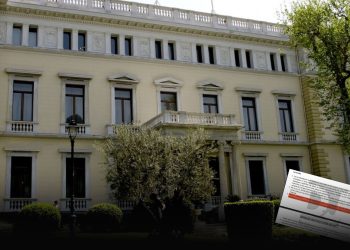
- Why a supposed Air Force celebration ended up as a deadly show
- Hard-hitting questions about Athens Flying Week, a privately run air show that nonetheless enjoyed full state backing.
- The political establishment is inexplicably shocked by the “revelation” that a critical air base was being “rented” to a private party for a very small fee.
- It took the loss of two Hellenic Air Force pilots for answers to be sought on critical operational issues facing the Air Force.
By Paris Karvounopoulos
The loss of two capable and experienced Hellenic Air Force pilots raises hard-hitting questions. Squadron Leader (Pilot) Ioannis Blesias, 40, and Flight Lieutenant (Pilot) Dimitrios Petrou, 37, paid with their lives for taking part in a private air show at Tanagra. Private, yes, but with an enormous share of “state involvement”, as it turns out.
The history of air shows in Greece begins in 2005. The then Chief of the Hellenic Air Force General Staff, Giorgos Avlonitis, organized the “Archangel” air show at Tanagra. It was a static and flying display of aircraft. Nineteen air forces and 12 aerospace and defense companies took part, with more than 200 aircraft and helicopters.


The event was organized exclusively by the Hellenic Air Force, and it was a great success. The safety measures for the air shows were meticulously supervised by operational officers of the Air Force.
The “Archangel” in the form held in 2005 was never organized again. In 2012, private initiative stepped in to “fill the gap”, if there was a gap at all.
Panagiotis Podimatas, through “ATHENS FLYING WEEK AIR SPORTS EVENTS S.A.”, an ordinary public limited company, took over the “evolution” of the “Archangel”.

The company reports share capital of €100,000 and, for the 2024 financial year, a turnover of approximately €623,880 and pre-tax profits of approximately €30,070. There is also a second company, “Panagiotis K. Podimatas ΑΕΒΕ”, which operates in the audiovisual/technical sector and is the main business entity of his group.
The “private Archangel” began in 2012 at Tatoi air base. The details of the agreement with the Ministry of National Defence were never made public. What was the “rent” the Air Force received for the use of the base? Who would have covered the insurance costs in the event of an accident, which is always a possibility at such events? Who paid for the support and use of the Air Force’s aircraft, as well as those arriving from abroad? From time to time there have been reports about the amount of rent the company paid to the Air Force. The sums mentioned were rather laughable. The highest figure that has been published and has not been denied is €25,000.


In 2014, Athens Flying Week “moved” to Tanagra air base. This is a very important base for the Air Force, as it is the “nest” of the Mirage 2000s and the Rafales. The facilities the base offers to Athens Flying Week are clearly a step up. The air show receives extensive media coverage, coverage that “drowns out” the questions a handful of journalists were raising about its cooperation arrangement with the official state.
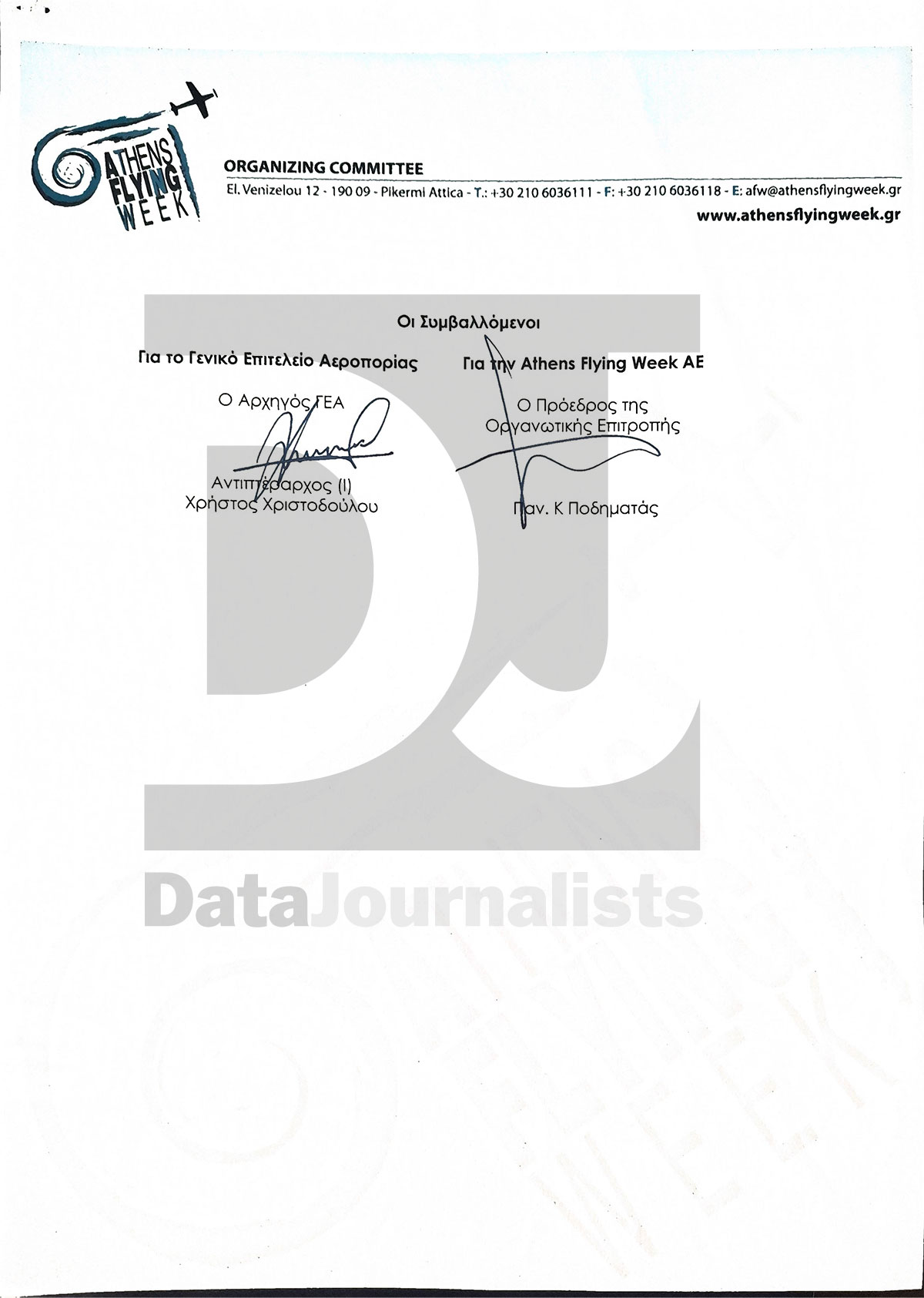
This cooperation was renewed annually until 2017. That year, a “Long-Term Memorandum of Cooperation” was signed between the private company and the Hellenic Air Force General Staff (HAGS).
Data Journalists have obtained the text of that memorandum. It says many interesting things, but not what financial benefit the Air Force would derive from the arrangement.
Among other things, it states that “the joint promotion of the activities of AFW is an important factor in strengthening the projection of our country’s image abroad” and that “the promotion of the overall Air Week event (AFW) will contribute to the greatest possible extent to the promotion of Greek tourism.”
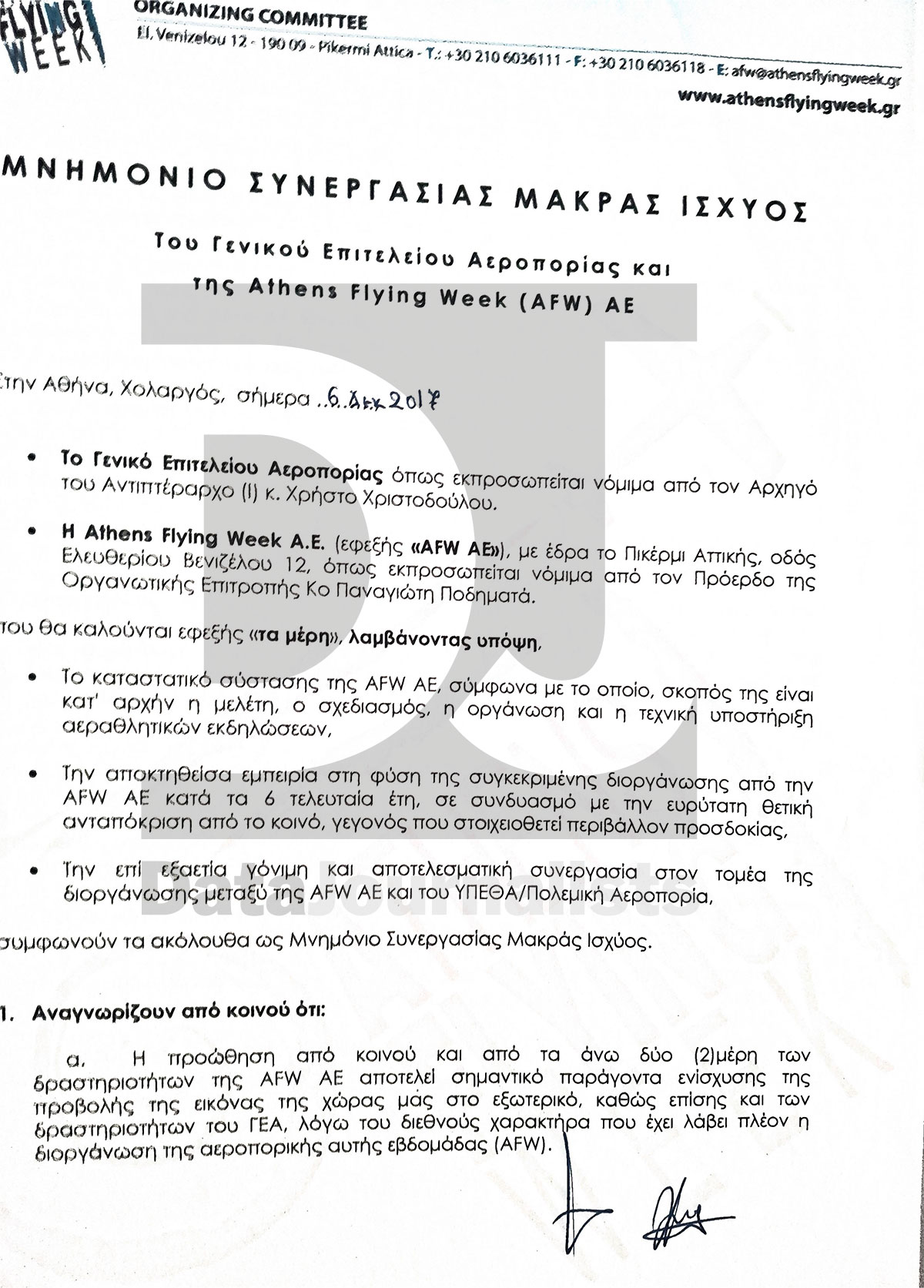
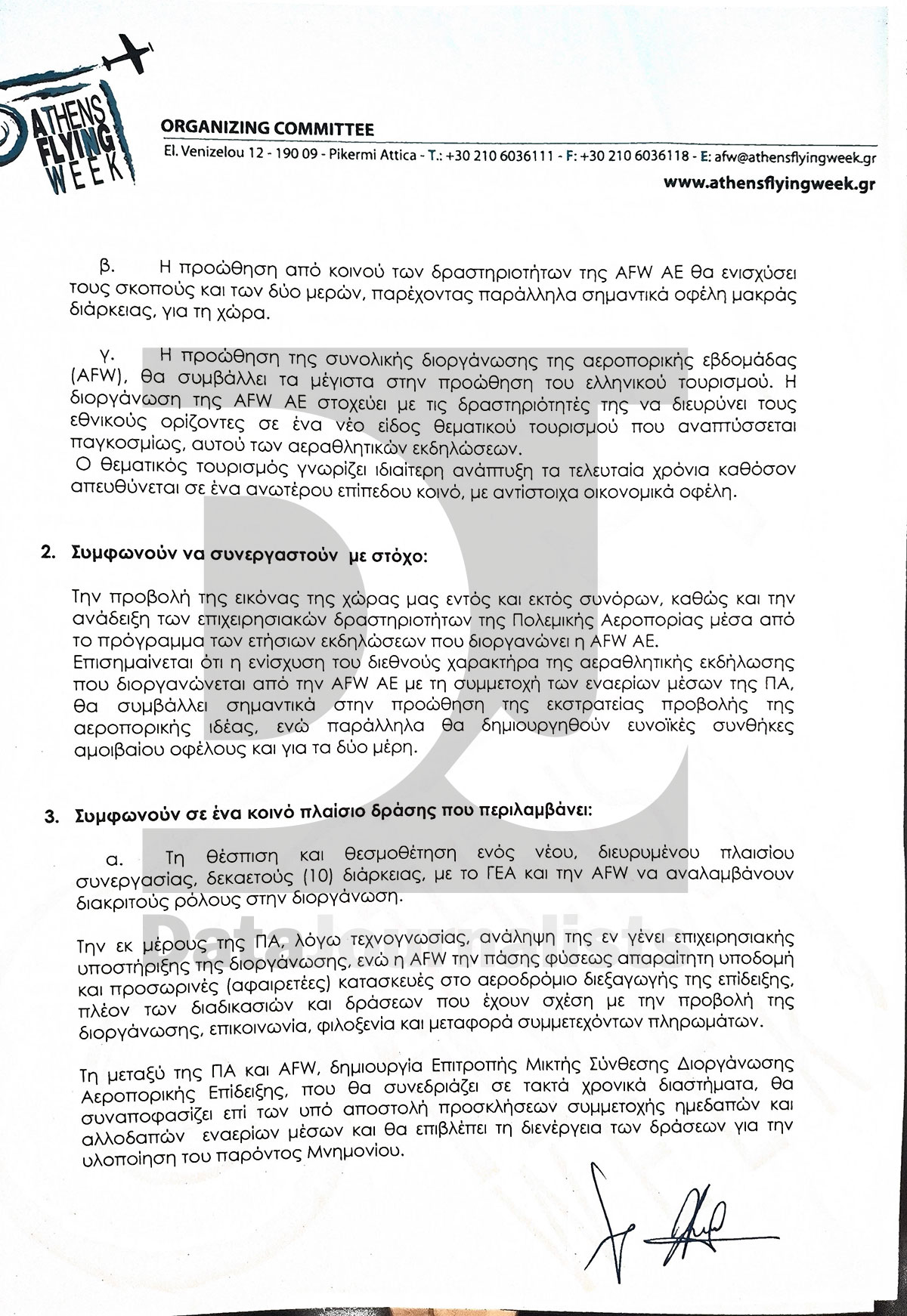
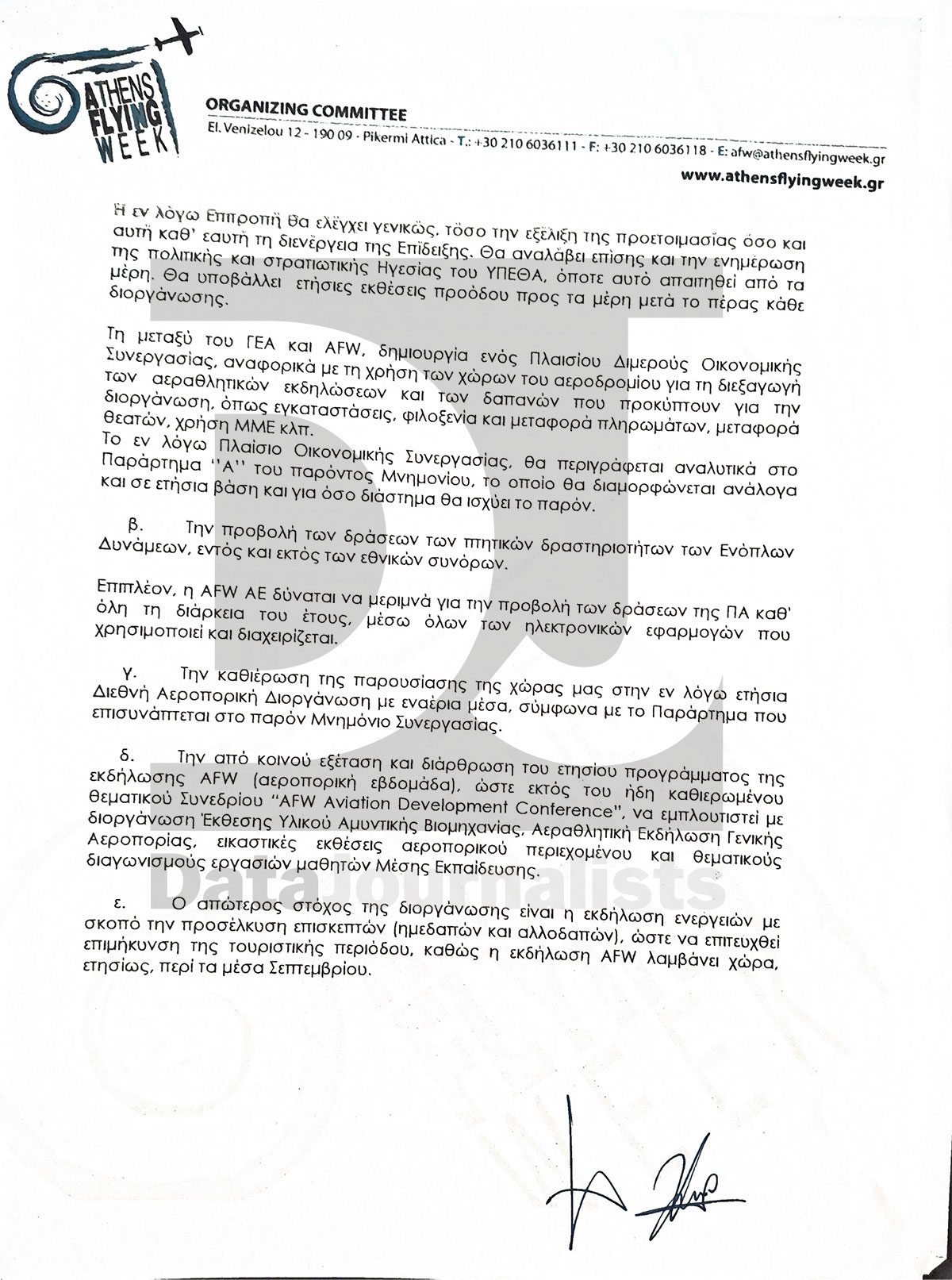


It also states that the Air Force will undertake, “due to its expertise, the overall operational support of the event, while AFW will provide all necessary infrastructure of any kind and temporary (removable) structures at the airfield hosting the display, in addition to the procedures and actions relating to the promotion of the event, communication, hospitality and transport of participating crews.”


The “roles” divided between the business and the state, represented by the Air Force, proved lopsided to the detriment of the latter. One only has to look at the flight programme of this year’s Athens Flying Week to see that most of the programme, and especially the aerial displays, is covered by aircraft of the Armed Forces. Not only the Air Force’s, but also those of the Army and the Navy.
It also emerges that AFW did not rely solely on financial support from its sponsors to “make ends meet” with the event. That would have been the normal arrangement for a private event. It turns out that the financial support provided by the state apparatus was more than significant. A telling example is the decision of the Region of Central Greece in August 2019.
5+1 Questions
But the questions that have arisen do not concern only the financial side of the affair. There are equally serious issues which, unfortunately, are only being raised for discussion after the deaths of the two pilots.
- Was there any provision for insurance cover for the pilots, not only the Greek ones, in the event of an accident, and if so, who was to provide it?
- Where should the relatives of the two pilots, as well as the Air Force, expect compensation to come from for the aircraft it lost, regardless of whether it was old?
- Was it an active aircraft in the Air Force’s fleet?
- Did the two pilots who were ordered to perform the display flight at Tanagra have the necessary training? What does that training consist of?
- The pilots of the F-16 ZEUS demonstration aircraft each fly at least 15 hours to perform a display programme. Did the same apply to the two pilots of the F-4 Phantom, an aircraft that is infinitely harder to fly than the F-16 for this kind of flight?
- And finally, a question posed by serving officers as well as experienced retired Air Force officers: can the Air Force afford the luxury of wasting flight hours and straining aircraft and flying personnel to put on air shows? The problem of aircraft availability is no secret, and every hour of training flight for the Air Force’s combat missions is precious.