- The investigations into Larissa, Volos, and Trikala have “gotten bogged down in
the mud.” - The exception is the prosecutorial investigation into Karditsa, which is reported
to have been completed, with responsibility reportedly pinned on both elected
officials and civil servants in the region. - Stelios Sourlas, a "bombshell" complaint to Data Journalists: "New Democracy
party officials have received compensation they were not entitled to, while
local residents still have not been compensated." - A lawsuit filed by 139 residents of Farkadona, 205 residents of Palamas, and 16
residents of Giannouli, over the flood defenses that were never built despite
the deadly onslaught of Storm Ianos in 2020. - The alert from the 112 emergency line came after 3.5 hours of being trapped.
- Where — and on whom — the Gourbatsis technical report pins responsibility.
by Vangelis Triantis
In just a few days, it will be three years since Storm Daniel struck the Region of Thessaly, leaving 17 people dead in its wake. Three years during which residents of the affected areas have been struggling to get back on their feet after the storm’s devastating onslaught — a storm over which a prosecutorial investigation was launched, ordered by the then-Prosecutor of the Supreme Court, Georgia Adeilini, and directed to the local prosecutorial authorities of Thessaly, with the aim of establishing whether any officials bore criminal responsibility.
The top prosecutorial official had requested that a series of actions or omissions be investigated, along with any possible mismanagement of funds, regarding the region’s flood defenses — particularly in relation to Storm Ianos, which had struck the area in 2020. However, according to information obtained by Data Journalists, to this day the fourfold prosecutorial investigation has still not been completed. The possible exception is the investigation into Karditsa, which, according to an article published last April by the newspaper Eleftheria, is reported to have been completed, with responsibility reportedly pinned on both elected officials and civil servants in the region. In the other three areas — Larissa, Volos, and Trikala — the prosecutorial investigations are not expected to be completed any time soon. The pace of Justice in the Daniel investigations is truly “impressive” — without, of course, anyone overlooking their complexity — though that is perhaps something the higher echelons of the Justice system ought to take into account. According to legal “sources,” conducting four separate investigations is a far more time-consuming process than merging all the case files into one, under the supervision of a senior prosecutorial official.
At the same time, well-known lawyer Stelios Sourlas — himself one of the flood victims — in a “bombshell” statement to Data Journalists, alleges that New Democracy party officials, with the help of local MPs and ministers, have received grossly disproportionate compensation they were not entitled to, while residents of Thessaly have still not been compensated at all. But let’s go back a little, to the days of the storm.
It was September 4, 2023, when Storm Daniel began battering Thessaly. The phenomenon was intense. The rain fell without let-up. According to the automatic weather station of the National Observatory of Athens (NOA)/meteo.gr network in Zagora, Pelion, a total of 1,096 millimeters of rain was recorded, 760 of which fell within a single day, on September 5, 2023. The rainfall caused streams and rivers to overflow. The raging waters covered hundreds of thousands of stremmata of Thessalian land. Property was destroyed. Houses, crops, and cars were submerged in water. Total devastation, and 17 dead.
The lawsuit by 139 residents of Farkadona
The outrage boiled over. From the very first hours, residents of the affected areas spoke of “negligence and incompetence” on the part of those responsible, arguing that despite the fact that the 2020 Ianos flood in Karditsa had already served as a warning, no steps had been taken to carry out the flood-defense works the area needed.
A telling example is the complaint filed by 139 residents of Farkadona, Trikala, in a criminal complaint submitted to the Trikala Court of First Instance Prosecutor’s Office a few months after the disaster, through their legal representative, Stelios Sourlas. The lawsuit is directed against the then-Regional Governor of Thessaly, Konstantinos Agorastos; the then-Deputy Regional Governor of the Trikala Regional Unit, Christos Michalakis; and the Minister of Climate Crisis and Civil Protection, Vasilis Kikilias.
“We are, all of us, residents of Farkadona, Trikala, which was literally submerged on September 7, 2023 by Storm ‘DANIEL’ — and above all by the negligence and incompetence of the responsible parties named in this complaint, who failed to ensure that flood-defense works were built so that we would not be flooded, even though they knew there was a serious risk of flooding, given that the ‘IANOS’ flood had already struck the area of Karditsa in September 2020. And while the Government at that time had declared the Prefecture of Karditsa to be in a state of emergency and had ordered the responsible authorities to proceed immediately with flood-defense works through direct-award contracts — precisely because of the urgent need to prevent the same scenario from happening again — the accused parties, even though they were aware of this as an extremely serious risk, nonetheless failed to carry out the absolutely essential flood-defense works. The result was the total destruction of Thessaly, and in particular of Farkadona, Trikala, which all of Greece watched as the water rose to a height of over 4.5 meters,” the criminal complaint states at the outset.
“Our lives were put at risk, our property was destroyed”
The 139 residents of Farkadona also place blame on how the situation was handled during the flood itself. As they put it, “during the flood, and afterward as well, they failed to see to our safety and to the evacuation of our homes, with the result that our lives were put at risk and our property — both movable and immovable — was completely destroyed.
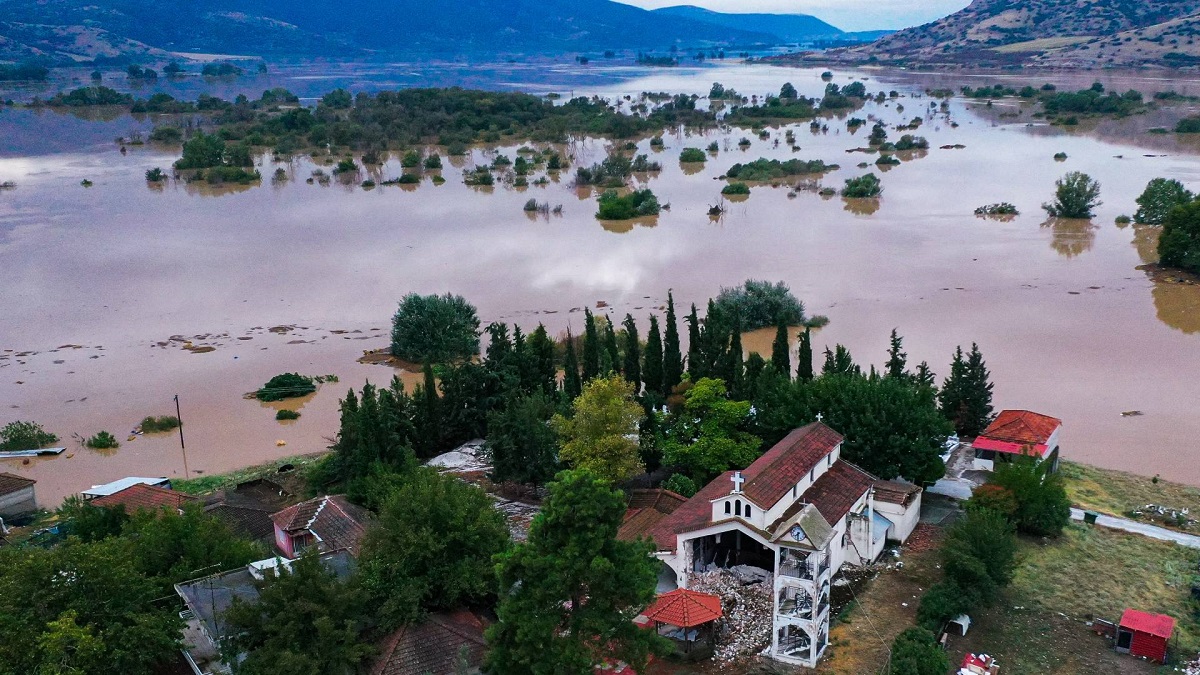
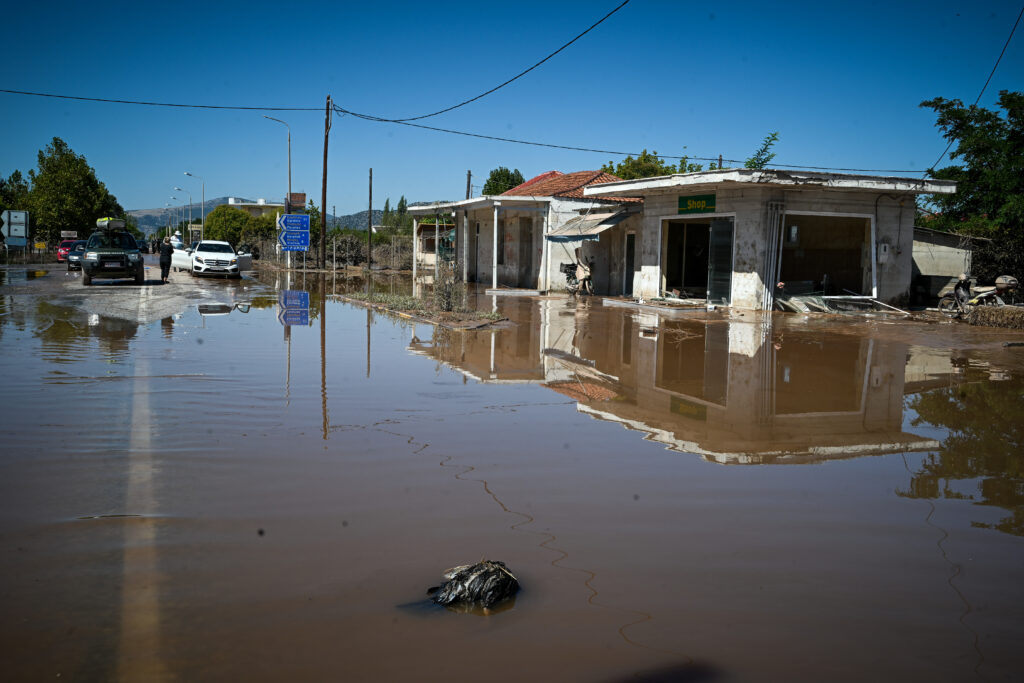
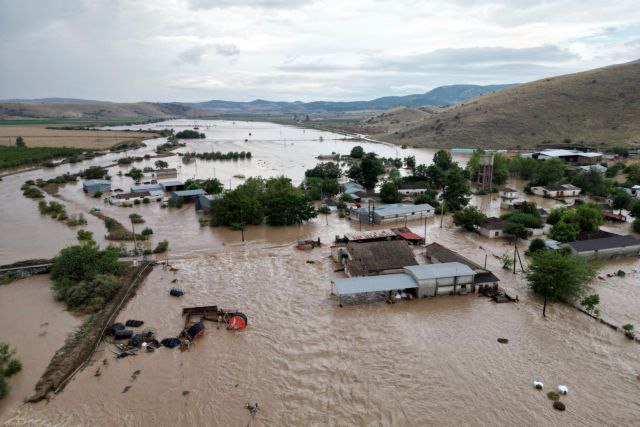
“Specifically, on Wednesday, September 7, 2023, at 10:00 p.m., the area of the town of Farkadona, Trikala began flooding from rainwater. At 11:30 p.m., within the space of half an hour, suddenly and without anyone informing us that a flood of the village was imminent, the water rose to half a meter. We immediately tried to contact all the responsible agencies — namely 112, 100, the Region, the Fire Service, the Police, and the Municipality — but no one gave us a responsible answer as to what was going to happen, nor did anyone come to help us. As time went by, the water level kept rising, and no responsible official appeared to help us or to tell us to leave, even though they had already known since Monday, September 5, 2023, that Ypereia, Palamas, and the villages along the course of the Enipeas and other rivers had flooded. The water rose sharply, with the result that we became trapped in our homes and unable to escape from them, hoping all the while that the worst would pass. There was zero information, and likewise zero help or support from any responsible party — state or otherwise. The 112 alert messages only began arriving after we had already been flooded and trapped in our homes, unable to leave them,” the criminal complaint further states.
The lawsuit by 205 residents of Palamas, Karditsa
Equally shocking are the allegations set out in a lawsuit filed before the Karditsa Court of First Instance Prosecutor’s Office by 205 residents of the village of Palamas, which was literally “drowned” by the storm. The lawsuit is directed against Mr. Agorastos, Mr. Kikilias, the former Mayor of Palamas, and any and all third parties responsible within the Police, the Fire Service, and the Municipal Authority, for the offenses of fatal endangerment and damage to another’s property, on the grounds that “they failed to ensure that flood-defense works were built, even though they knew there was a serious risk of flooding” — a risk underscored by Storm Ianos as well.
The complainants describe the shocking events of the early morning hours of September 6, 2023, when the storm struck the area.
“Specifically, on September 6, 2023, at 5:00 a.m., the area of the town of Palamas began flooding from rainwater. By 7:00 a.m., we had already begun, on our own, rescuing people from their homes in the Laka Vardaka area, around the 1st Gymnasium of Palamas, on Aris Velouchiotis Street, and elsewhere. By midday on September 6, 2023, the area south of Palamas, toward Kalyvakia, was completely flooded after the embankment outside the village of Kalyvakia (at the location known as ‘Plystra’) gave way. From that point on, citizens using tractors and platforms rescued the elderly and anyone else in danger, and we then tried to save whatever cars and machinery we could from the flooded areas — but in vain. Officials kept reassuring us, telling us there was no reason to worry, with the result that many of us were persuaded and went to sleep peacefully that night, utterly exhausted from the incredible ordeal of that day,” the complaint states at the outset.
The 112 alert came after 3.5 hours of being trapped
The complainants went on to describe what followed the next day. As they tell it, they fought the storm entirely on their own, with no information whatsoever from the responsible authorities. Even the alert from the 112 emergency line only came after they had already been trapped for 3.5 hours.
“In the early hours of September 7, 2023, at around 3:00 a.m., we suddenly heard a muffled, unfamiliar sound within the town of Palamas. There was absolutely no information from any responsible authority — the Fire Service, the Police, the Municipality, the Region, the State, Civil Protection, or the 112 line. Within fifteen minutes, the water level had risen to as much as 1.50 meters, trapping us inside our homes with no way to escape. The first 112 alert didn’t arrive until much later — and far too late to do any good — at 6:36 a.m., by which point we had already been trapped for 3.5 hours. From that point on, we were at the mercy of volunteers, since not a single responsible official ever came, either to free us, or to inform us, or to do anything else at all.”
The lawsuit by 16 residents of the Giannouli area in Larissa
The same allegations were made by 16 residents of the workers’ housing estate in the Giannouli area of Larissa, who watched their homes get “swallowed” by the raging waters. The lawsuit is directed against Mr. Agorastos, Mr. Kikilias, deputy regional governors, and any other party bearing responsibility within the Police, the Fire Service, or the Municipal Authority, for the offenses of fatal endangerment and damage to another’s property.
The residents allege that not only was there negligence in the construction of the necessary flood-defense works, but also that no steps were taken to protect them during the flood itself, even though the authorities knew that the surrounding areas had already flooded.
Specifically, they made the following allegations in the criminal complaint drawn up by their legal representative, Stelios Sourlas.
“…In addition, during the flood and afterward as well, they failed to see to our safety and to the evacuation of our homes, nor did they inform us so that we could evacuate them, with the result that our lives were put at risk and our property — both movable and immovable — was completely destroyed. Specifically, we immediately tried to contact all the responsible agencies — namely 112, 100, the Region, the Fire Service, the Police, and the Municipality — but no one gave us a responsible answer as to what was going to happen, nor did anyone come to help us. As time went by, the water level kept rising, and no responsible official appeared to help us or to tell us to leave, even though they had already known since Monday, September 5, 2023, that Ypereia, Palamas, and Farkadona (from September 8 onward) had flooded, along with the villages along the course of the Enipeas, the Pineios, and other rivers,” the criminal complaint states.
Moreover, as the residents noted, in this case too the 112 system only kicked in after the fact — once the waters had already flooded the area.
“The water rose sharply, with the result that we became trapped in our homes and unable to escape from them, and we hoped that the worst would pass. There was zero information, and likewise zero help or support from any responsible party — state or otherwise. The 112 alert messages only began arriving after we had already been flooded and trapped in our homes, unable to leave them,” the complaint alleges.
The Gourbatsis technical report, which pinpoints responsibility
State negligence and the failures of those in charge have been identified in a technical report drawn up by the former Deputy Chief of the Fire Service, Lieutenant General (ret.) Andrianos Gourbatsis, concerning the deadly floods in Thessaly. Specifically, the Gourbatsis report speaks of “criminal errors and omissions” on the part of the Region of Thessaly and its supervised services, the Fire Service, the Municipalities, and the General Secretariat for Civil Protection, while it stresses that the elements of the offense of “fatal endangerment” are established at the level of a felony.
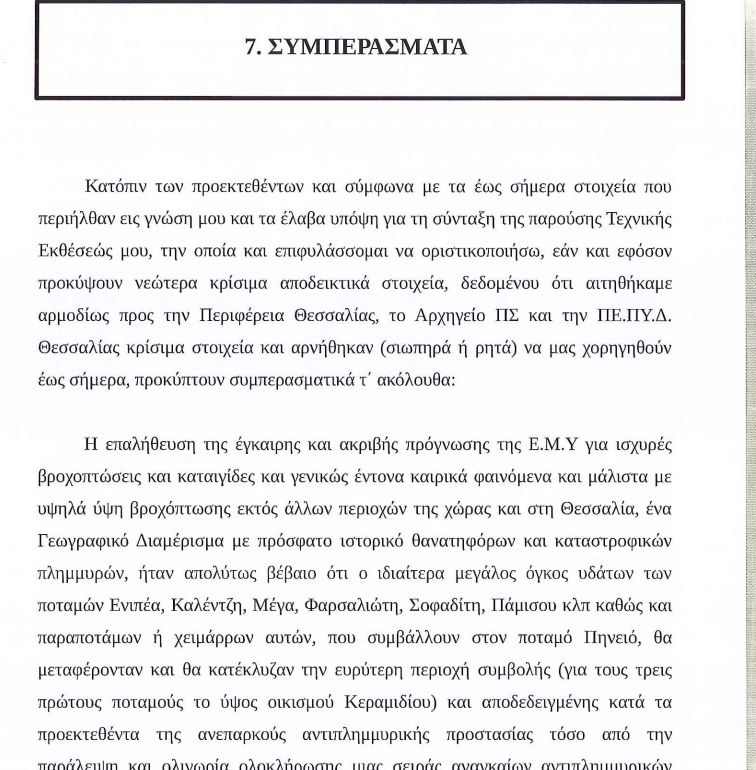
According to the Gourbatsis report, based on the “recent history of deadly, catastrophic floods, it was absolutely certain that the exceptionally large volume of water from the Enipeas, Kalentzis, Megas, Farsaliotis, Sofaditis, Pamisos, etc. rivers, as well as their tributaries and torrents, which feed into the Pineios River, would be carried downstream and would inundate the wider area…”
However, despite the history of deadly, catastrophic floods and the warning issued by the National Meteorological Service about the approach of Storm DANIEL, there was “inadequate flood protection.” Tellingly, the report finds “a failure and negligence in completing a series of necessary flood-defense (technical) works,” but also, at the same time, “a delay in clearing river beds of sediment and debris, a failure to reinforce embankments at critical points, and the non-operation of flood-control pumping stations due to power outages.”
The Fire Service’s Lieutenant General (ret.) stresses that “all of these facts, data, and characteristics were already known to the leadership of Civil Protection — and specifically to the General Secretariat for Civil Protection, the Fire Service, the Command of the Thessaly Regional Fire Brigade Directorate, the Region of Thessaly, and the Municipalities of all its Regional Units, as well as other involved agencies — at least since September 2, 2023.” In other words, “three days before the Mediterranean storm [Daniel] began striking Thessaly with exceptionally high rainfall totals.”
Consequently, those responsible were obligated “to see to, act on, and undertake — in good time — effective rescue-focused actions and measures, first and foremost, to prevent, protect against, and avert, by every means, the loss of life of the 17 victims counted in total to date across the entire Region of Thessaly, and the exposure to danger of the life and physical safety of the remaining residents of the specific settlements and towns affected.”
More specifically, on the “prevention” front, Mr. Gourbatsis stresses in his report, among other things, that “there was no integrated flood-prevention plan at the central-government level — particularly in the form of mountain-watershed engineering works and, downstream from those, other technical works in the plain — that would have aimed at the holistic flood protection of Thessaly, combined with the establishment and construction of an Early Flood Warning System. This system would, moreover, be linked to the European Emergency Number 112, providing information and data to keep the public informed, and would be triggered with targeted geotargeting for the threatened areas, settlements, and towns — rather than, as is the case today, approximately and vaguely.”
The report also notes that, despite the fact that following the 2020 Ianos and 2022 Diomedes storms “funding had been secured for the Region of Thessaly, with particularly significant resources from various sources, for the construction — via a process that departed from the standing regulations governing Public Works — of the necessary technical works needed to strengthen its flood defenses and protect the lives and property of its residents,” nevertheless, on the day Storm DANIEL struck, “not all of the flood-defense works had been completed (i.e., the completion of flood-defense works/studies concerning the implementation of preventive measures to address the negative consequences of future natural disasters…).”
On the “readiness” front, the Lieutenant General (ret.) identified failures on the part of the Civil Protection Mechanism.
“When Mediterranean Storm Daniel began striking the Region of Thessaly, the Civil Protection Mechanism — despite having been informed in advance of the arrival of heavy rain and storms accompanied by hail, a high frequency of lightning strikes, strengthened winds, and a noticeable drop in temperature — found itself in a state of disorganization and lack of coordination, in the sense of a lack of readiness, primarily at the level of proper preparation, planning, and organization,” Mr. Gourbatsis stresses to Data Journalists.
The Gourbatsis report also identifies failures with respect to how the flooding itself was handled once underway.
“The Civil Protection Mechanism, and in particular the Fire Service Mechanism, was reorganized at a later point, but it was slow to do so and did not respond immediately, or with the necessary personnel, resources, and equipment — above all to rescue the 17 fellow citizens/residents who lost their lives, as well as all those who were trapped in flooded settlements, inside their homes or other buildings or areas, and who were evacuated only after a delay of 2 to 3 days, putting their lives and physical safety at risk as well,” the report states.
The “18” summoned by the Karditsa Prosecutor’s Office
As for the four prosecutorial investigations, they remain ongoing at the Prosecutor’s Offices of First Instance in Larissa, Karditsa, Trikala, and Magnesia. According to an article in the newspaper Eleftheria by journalist Vangelis Kakaras, as of July 2025 the Karditsa Prosecutor’s Office had sent summonses to a total of 18 current and former elected officials, as well as civil servants, calling on them to provide explanations regarding three criminal offenses: flooding caused with possible intent or negligence, from which danger arose to human life, third-party property, and public-utility infrastructure; commonly dangerous damage caused with possible intent or negligence, from which danger arose to third-party property and human life; and manslaughter by negligence, committed by an individual under a duty to act, through repeated omission.
According to the article, the Karditsa Prosecutor’s Office had been due, by the end of June, to forward the case file — with draft charges at the misdemeanor level — to the Larissa Court of Appeals Prosecutor’s Office, on account of the alleged involvement of individuals with special jurisdictional status. However, according to information obtained by Data Journalists, the file has still not been forwarded to this day. As for the other three Prosecutor’s Offices (Larissa, Trikala, and Magnesia), their investigations are continuing and are not expected to be completed before next winter at the earliest.
Stelios Sourlas: “There is indisputable state responsibility — And it has names attached”
In a statement to Data Journalists, lawyer Stelios Sourlas — who is himself a flood victim — launches a broadside against government officials over the issue of compensation. As he points out, New Democracy party officials, with the help of local MPs and ministers, have received grossly disproportionate compensation they were not entitled to. All the while, residents of Thessaly are still waiting to receive the compensation they are owed.
“Three years have now passed since the DANIEL and ELIAS floods, which laid bare, in the starkest possible terms, the complete and total absence of the state apparatus — both in terms of prevention, through flood-defense works that were nonexistent and heavily publicized purely for vote-grabbing purposes, and that were, moreover, grossly overpriced, and afterward, through the utter absence of a welfare state to help heal the wounds of the disaster. Thessaly was left to fend for itself, both before the floods and after them. The wildly inflated compensation that was supposedly promised to Thessalians in the first days — meant to deceive the long-suffering, trusting Greek people yet again, ahead of the local elections that followed — was, in reality, never actually paid out! The amount of compensation was gradually whittled down to next to nothing, and that amount was then cut back even further by an unbelievable maze of required bureaucratic procedures, with the result that poor people who “had nowhere to lay their heads” still, three years later, have not received even the reduced compensation they were entitled to. This stands in stark contrast to party officials of the current Government, who, with the help of local MPs and Ministers, received grossly disproportionate compensation they were not entitled to. This is today’s so-called welfare state — one whose actions, carried out with possible criminal intent, destroyed Thessaly. My clients — flood victims from the Municipality of Farkadona in Trikala, the Municipality of Palamas in Karditsa, Ypereia in Farsala, and the workers’ housing estate in Giannouli, as well as the businessman Konstantinos Soukos, who suffered damage to his facilities exceeding €160 million — are watching with keen interest for the outcome of the judicial investigations and for the exemplary punishment of all those responsible. “And there is indisputable state responsibility — and it has names attached, as documented in the criminal complaints we have filed. The crime of Thessaly’s destruction will not go unpunished, and Greek Justice will do its job.”