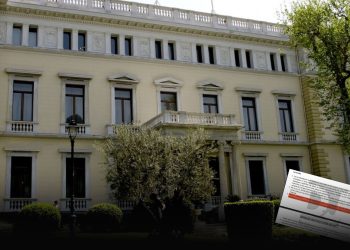
- A few months after the nationwide blackout of Greek airspace, they are shamelessly playing games with the Hellenic Civil Aviation Authority (HCAA) and the management of air traffic.
- What the radar Information System, codenamed DPS, is, and why it is the backbone of air navigation.
- Coincidences: The existing system was procured in 1991 through a direct award by the government of Mitsotakis’s father to the company Thomson (today Thales).
- How the original 2018 contract, worth €26.9 million, reached €62 million (excluding VAT) in 2022, rose to €79.5 million in April 2025, soared to €103.5 million in July 2025, shot up to €128.9 million in August 2025, touched €159.9 million after the blackout in January 2026, and now stands at €166.7 million.
By Aris Chatzigeorgiou
Even the pretense of propriety has been abandoned amid the frenzy of direct awards for procurements worth billions of euros. In one such process, conducted without a tender, for the Athens FIR radars, where the cost has already increased sixfold, a Negotiating Committee was appointed to deal with the French company Thales. And when the Committee demanded that negotiations be halted because the specifications were being manipulated, they simply replaced it with another, smaller one.
The case Data Journalists are revealing today is a telling example of how far the government’s maneuvering has gone beyond all limits in its drive to close deals “here and now” and get the signatures on paper. The arena for these maneuvers is the Hellenic Civil Aviation Authority (HCAA) and the management of air traffic over Greek airspace, a system already burdened by serious failings and direct awards going back years:
- At the start of 2026, the Athens FIR turned into a “black hole” for air navigation, as all aircraft traffic was halted for hours after communications collapsed, causing widespread confusion. In the findings that were published, the blame fell on obsolete systems that can no longer be repaired or maintained. The head of the HCAA, G. Saounatsos, was removed, and to this day no replacement has been appointed.
- The system at the center of all these Committees being built up and…torn down is the radar Information System, codenamed DPS. Its story begins in the 1990s as the PALLAS system, and once again the procurement was made through a direct award, in 1991, by the government of Mitsotakis senior to the company Thomson. The installation was completed in 1999, and a host of upgrades followed, always carried out by the same company, which was renamed Thales.
This system is the backbone of air navigation, as it gathers data from the radars and monitors the execution of the flight plans filed by the thousands of aircraft that pass through the Athens FIR every day, whether bound for a Greek airport or for other countries.
Discussions about installing a new system began as far back as 2017, and with them began a fresh “back and forth” over the upgrades proposed by Thales. Initially, the government requested approval for an upgrade, and the Hellenic Single Public Procurement Authority (formerly the Public Procurement Authority, now known as HSPPA) gave its consent at a cost of €26.9 million. The contract did not move forward, however, because in 2018 Thales came back and proposed upgrading to a different, improved version of the system.
The contract did not move forward, and the government of Mitsotakis junior then submitted a request to the HSPPA for a direct award to Thales at a cost of €62 million excluding VAT, on the grounds that new, more advanced systems had emerged. The HSPPA approved it in March 2022, with the system due for delivery in February 2024. Instead, by March 2024 the only thing that existed was a ruling by the Court of Audit (Chamber VII) refusing to approve the signing of the contract. The reason? The contractor had changed: the HSPPA had approved a contract with Thales France in 2022, but in January 2023, just before Tempi, negotiations began with Thales Hellas.
Another two years went by, and in April 2025 the HCAA’s management triumphantly announced that “the determination of the framework of technical and economic parameters with Thales France for the upgrade of the Air Traffic Management system has finally been completed.” The same announcement stated that “the first mixed team of Air Traffic Controllers and Electronics personnel is already at the company’s facilities in Paris for full briefing and familiarization with the system.” At that stage, the cost of the contract had already risen to €79.5 million. But in July 2025, with new additions, it took off to €103.5 million, and in August, when it went back to the HSPPA for approval, it had shot up to €128.9 million.
After the air traffic blackout last January, the Ministry of Infrastructure and Transport announced that an “official invitation to negotiate was being sent to the company, with the aim of finalizing the offer and submitting the file to the Court of Audit.” By that stage, the cost had reached €159.9 million, and the target was to sign a contract on March 31, 2026, so that the system could enter operation on November 1, 2028.
But this process did not move forward either, and in May it started over from the beginning, “split” into two parts. The radars were taken out of the procurement to be tendered separately at a cost of €33.7 million. As a result, the direct award to the French company (the exact term is “public contract with negotiation without publication”) was reduced to €126.2 million. Thales, however, is not worried, because the negotiation includes an option, that is, the possibility of extending the contract at an additional cost of €40.5 million. To sum up, the discussion that began at €26.9 million in 2017 has now reached, happily enough, €166.7 million!
The “negotiation without publication” begins under Article 32 of Law 4412 on public procurement (as is the case with hundreds of high-value awards). However, because a negotiation must take place, as the same law requires, the process is entrusted to a five-member Committee set up from senior HCAA officials. A nightmarish summer would follow, with the government pressing the Committee by every means to reach a conclusion so that the contract could be signed.
After six meetings, in early August the Negotiating Committee reached a majority opinion in favor of terminating the process. It refused to open the Financial Offer, arguing that Thales’s Technical Offer did not meet the full set of specifications laid down by the HCAA for the DPS system. In essence, it recommended that the process be canceled and a tender be run from scratch.
Part of the murky backstory is revealed in the official Minutes of the HCAA Board of Directors meeting held on September 9, 2026, which were published (surprisingly) the same day on the Diavgeia transparency portal of the Ministry of Infrastructure and Transport. There, the Acting Head, Georgios Vagenas, states that the Negotiating Committee took the view that “the technical specifications were mandatory in their entirety,” “judged that Thales’s proposal does not meet the technical specifications,” and “concluded its work definitively, returning the sealed envelope containing the financial offer to the Procurement Directorate.” However, Mr. Vagenas decided to press on with the process by dribbling past the obstacle.

He sent, that is, a letter to Eurocontrol, the European Organisation for the Safety of Air Navigation, asking whether the technical specifications are mandatory in their entirety. He even admits that “the Board’s decision to send a letter to EUROCONTROL was in reality the adoption of the opinion of the Committee’s minority” (a member who dissented). At precisely this point, within a few lines, the Acting Head decides to set up a new Negotiating Committee because “a serious reason arises.”
For the Committee to be changed, there really must be a serious reason, and it must be documented in detail. For example, it would have to be shown that the Committee’s members acted against the instructions they had received, possibly with intent to defraud or to obtain a benefit. Here, however, the decision states plainly: “No misconduct on the part of the members arises or is attributed to them such as to require that they be called to a hearing.” The reason put forward as serious is that the Committee “concluded its work,” and not the arguments the majority uses to justify that, namely that Thales did not meet the specifications set by the HCAA itself.
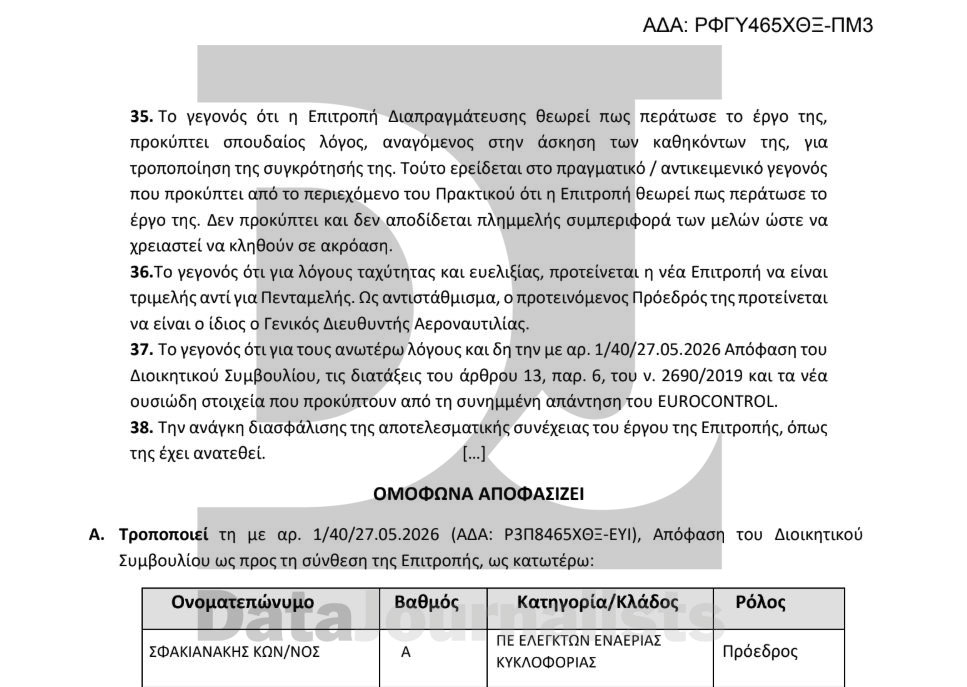
The decision to replace a five-member committee with a three-member one is also worded in a telling way: “For reasons of speed and flexibility, it is proposed that the new Committee be Three-member instead of Five-member. As a counterbalance, its proposed Chair is to be the Director General of Air Navigation himself.” The term “counterbalance” sounds somewhat strange when one considers that the same person, the Director General of Air Navigation, K. Sfakianakis, also took part in the previous Five-member Committee, but as an alternate member.

The “wagging tongues,” however, link the “counterbalance” to another fact. K. Sfakianakis is one of three candidates in the selection process run through ASEP last June to choose a new Head of the HCAA, which has not borne fruit. To be precise, the Director-General ranks second on points, while first, by a small margin, is G. Vagenas himself, who is performing the duties of Head as Deputy Head. This means that the two central figures in the negotiation with the French company Thales are vulnerable to any pressure exerted by the Minister of Infrastructure and Transport, Christos Dimas, to “get the job done.” To complete the picture of the scheme, we should note here that last October the HCAA became a legal entity under public law (NPDD), so responsibility for decisions now rests with the Head, whereas until then every decision was signed by the Minister himself.
Needless to say, the new three-member Committee also includes the member who had dissented and proposed sending the query to Eurocontrol. It is also worth recalling that when the five-member Negotiating Committee was set up last May, G. Vagenas’s decision stated that it “would remain active until the signing of the relevant contract.”